
Linked List In Java
Linked List in Java
The LinkedList class in Java is an implementation of the List interface that provides a doubly-linked list data structure. This means that each element (or node) in the list contains a reference to both the next and the previous node, allowing for bidirectional traversal. This flexibility makes LinkedLists a powerful alternative to other data structures like arrays or ArrayLists, particularly in applications where the size of the data set is not known in advance or where frequent insertions and deletions are performed.
Unlike an ArrayList, which uses contiguous memory allocation, a LinkedList connects elements through references. This characteristic allows for efficient memory usage and faster insertions and deletions since elements do not need to be shifted as they would in an array. For example, if you need to insert an item in the middle of an ArrayList, all subsequent elements must be moved one position to the right, which can be time-consuming for large lists.
Declaration and Initialization
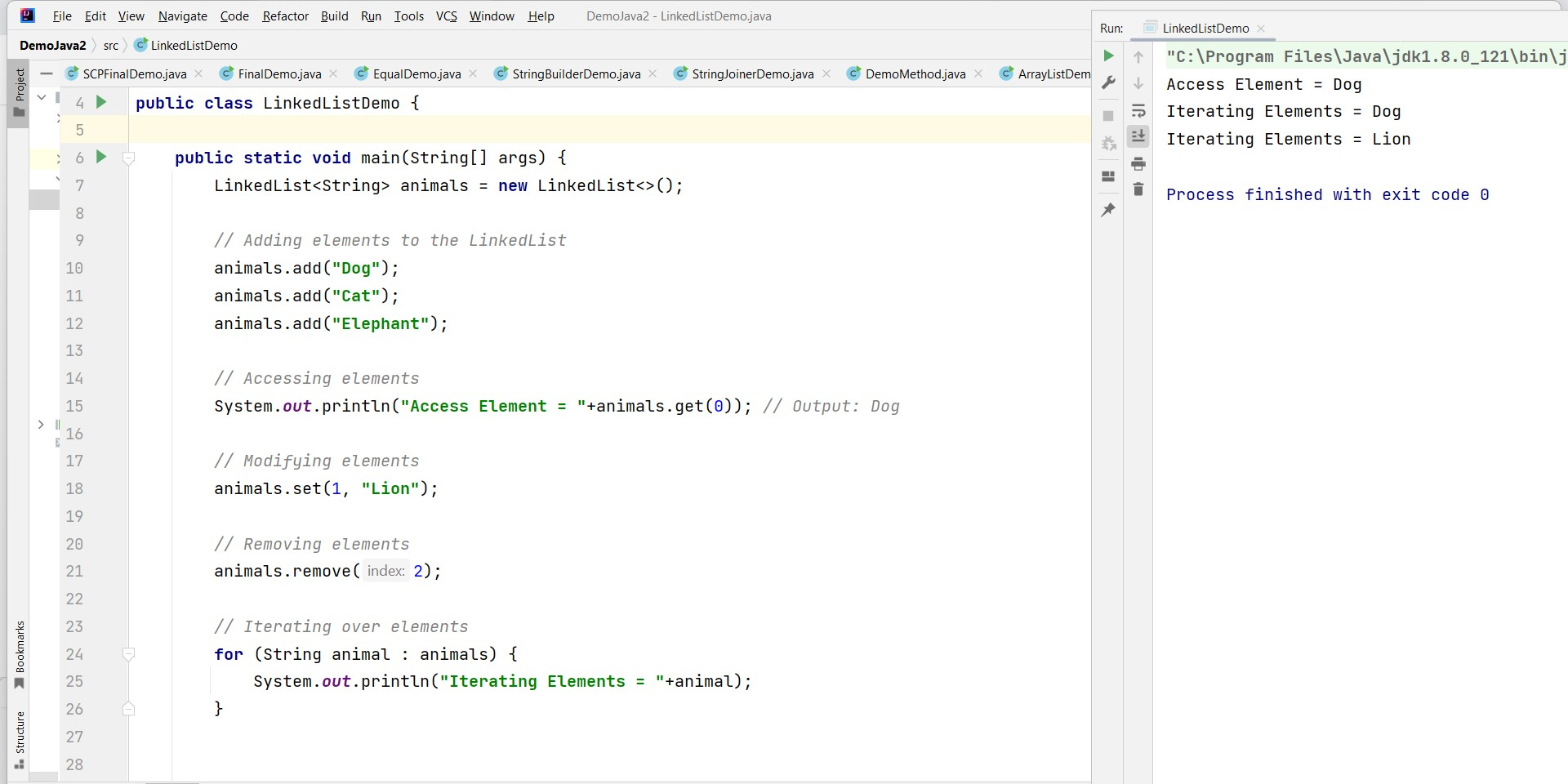
To use a LinkedList in Java, you need to import the java.util.LinkedList package. Below is an example of declaring and initializing a LinkedList:
import java.util.LinkedList;

public class Example {
    public static void main(String[] args) {
        LinkedList<String> animals = new LinkedList<>();
        // Adding elements to the LinkedList
        animals.add("Dog");
        animals.add("Cat");
        animals.add("Elephant");

        // Accessing elements
        System.out.println("Access Element = "+animals.get(0)); // Output: Dog

        // Modifying elements
        animals.set(1, "Lion");

        // Removing elements
        animals.remove(2);

        // Iterating over elements
        for (String animal : animals) {
            System.out.println("Iterating Elements = "+animal);
        }
    }
}
Common LinkedList Operations
Here are some commonly used operations with LinkedList:
- add(element): Adds an element to the end of the LinkedList.
- get(index): Retrieves the element at the specified index.
- set(index, element): Replaces the element at the specified index with a new element.
- remove(index): Removes the element at the specified index.
- size(): Returns the number of elements in the LinkedList.
- isEmpty(): Checks if the LinkedList is empty.
- clear(): Removes all elements from the LinkedList.
These operations allow for efficient management of collections of elements. For instance, if you want to add elements dynamically based on user input, a LinkedList is a suitable choice.
Advanced LinkedList Features
In addition to the basic operations, the LinkedList class provides several advanced features. One such feature is the ability to add elements at specific positions using the add(index, element) method. This method allows you to insert an element at a particular index, shifting subsequent elements to the right.
LinkedList<String> fruits = new LinkedList<>();
fruits.add("Apple");
fruits.add("Banana");
fruits.add(1, "Orange"); // Insert "Orange" at index 1
System.out.println(fruits); // Output: [Apple, Orange, Banana]
Another useful feature is the addAll(Collection c) method, which allows you to add all elements from another collection to the LinkedList. This can be particularly helpful when merging two lists.
LinkedList<String> moreFruits = new LinkedList<>();
moreFruits.add("Grapes");
moreFruits.add("Mango");
fruits.addAll(moreFruits);
System.out.println(fruits); // Output: [Apple, Orange, Banana, Grapes, Mango]
Edge Cases & Gotchas
While working with LinkedLists, there are some edge cases and gotchas to be aware of. For instance, if you attempt to access an index that is out of bounds (greater than or equal to the size of the list), a java.lang.IndexOutOfBoundsException will be thrown. Always ensure that the index is valid before accessing or modifying elements.
Another common mistake is forgetting to check if the LinkedList is empty before performing operations like remove() or get(). Trying to remove an element from an empty list will also result in an exception.
Performance & Best Practices
The performance of LinkedLists is generally favorable for operations that involve frequent insertions and deletions, as these operations run in constant time O(1) when the reference to the node is known. However, accessing elements by index is less efficient, with a time complexity of O(n) since the list must be traversed from the head to the desired index.
When using LinkedLists, consider the following best practices:
- Use LinkedLists when you expect a lot of insertions and deletions, especially in the middle of the list.
- Avoid using LinkedLists when you need to frequently access elements by index.
- Always check for null or empty lists before performing operations to prevent exceptions.
- Consider using a Deque (double-ended queue) interface if you need to perform operations at both ends of the list.
Conclusion
In conclusion, the LinkedList class in Java offers a robust and flexible data structure for managing collections of elements. Its unique features and operations make it suitable for various applications, especially where dynamic data management is required. Here are the key takeaways:
- LinkedLists are implemented as doubly-linked lists, allowing for efficient insertions and deletions.
- They provide a range of operations such as add, get, set, and remove.
- Advanced features include adding elements at specific positions and merging collections.
- Be cautious of edge cases like index out-of-bounds and operations on empty lists.
- Follow best practices to ensure optimal performance and avoid common pitfalls.
