Self Healing Test Automation: How CoTester’s AgentRx Helps QA
Development and testing teams today widely use test automation to automate test creation and execution. Sure, this has made testing processes much faster and efficient.
But here’s a reality check: QA teams using testing frameworks spend at least 20 hours per week creating and maintaining automated tests.
Traditional automation test scripts are rigid and highly sensitive to app changes. Even minor UI updates such as renaming a button, can cause the test scripts to fail.
As a result, your QA team spends a significant amount of time fixing these failed tests rather than focusing on testing your app’s critical features and workflows.
What if there was a way these tests could detect potential failures and fix themselves automatically so you don’t have to manually update scripts over and over again?
This is precisely what self-healing automation, often called auto healing or auto heal testing, helps you do.
In this blog, we’ll discuss how self-healing automation works and why it’s so important for modern development cycles.
We’ll also explore how TestGrid CoTester, powered by its AgentRx self-healing engine, helps teams cut down on brittle tests and reduce test maintenance overhead.
What Is Self-Healing Test Automation and Why Does it Matter?
Automated tests use locators such as name, ID, XPath, and type to interact with your app’s elements and check if everything is working as expected. But continuous changes in your app can alter these elements, which can potentially lead to test failures because of UI mismatches.
Self healing test automation, or auto-heal testing, updates your tests automatically whenever you make changes to the code.
This ensures that the tests are always in sync with the latest version of your app and helps you continuously run tests without interruptions and manual maintenance.
Modern enterprise-grade AI software testing agents, like CoTester, are designed exactly for this, adapting dynamically as your app evolves. Its AgentRx engine ensures tests stay in sync even through major UI changes.
Why use self-healing test automation?
1. Fewer failed tests
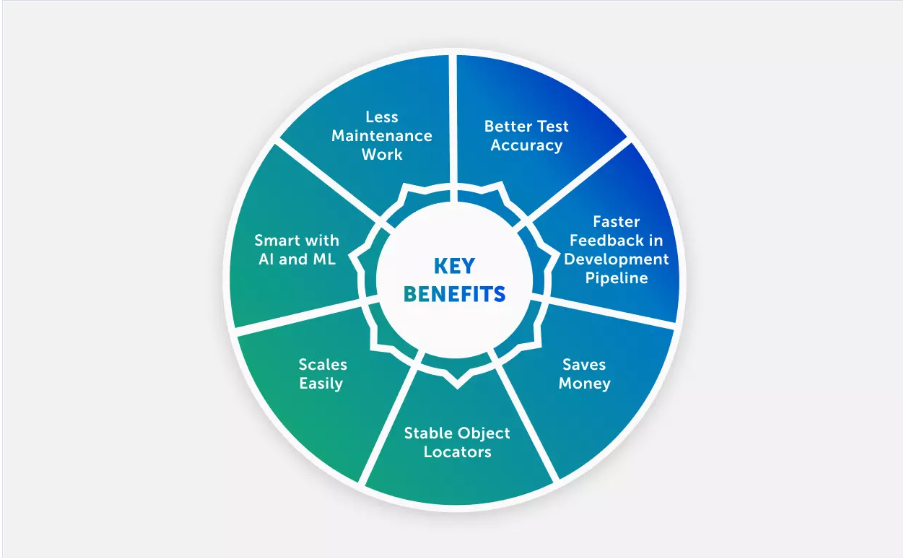
Test failures occur when your app’s UI or locators change but the test scripts don’t adapt to those modifications.
With auto healing or self healing, scripts automatically update their locators to adjust to these changes, and ensure relevant scenarios continue to execute as specified in requirements. This helps you reduce time spent on fixing tests and avoid delayed app development and release.
For instance, CoTester’s AgentRx doesn’t just adapt to renamed buttons. It can even handle structural redesigns in real time.
2. Prevents object flakiness
Errors like “NoSuchElementException” because of missing object locators might lead to test flakiness. QA teams have little control over this and can have a tough time ensuring the stability of test cases.
Self healing automation updates test designs automatically for the app and reduces the risk of failed tests.
3. Better test coverage
Self healing test automation helps you build a resilient and effective test suite that covers different scenarios including user flows, edge cases, and features.
Further, it reduces execution of redundant test cases by preventing duplicate scripts and ensures thorough testing of new updates and features of your app. This helps you improve delivery times and get better ROI on your testing budget.
4. Lower maintenance costs
Traditional automation requires your team to constantly update test scripts every time your app goes through changes. This is expensive and inefficient.
Self healing helps you reduce this extra effort and maintenance overhead by updating scripts dynamically to app changes so your team can focus on critical tasks.
This is where CoTester shines: AgentRx updates scripts dynamically so your team doesn’t burn cycles fixing brittle locators.
5. Quick feedback loops
Updating scripts manually takes up a lot of time and delays feedback. Self healing test automation detects issues during test execution and updates scripts to continue running.
This helps your dev team get faster feedback on the recent app changes and make necessary changes before issues compound.
How Does Self-Healing Automation Work?
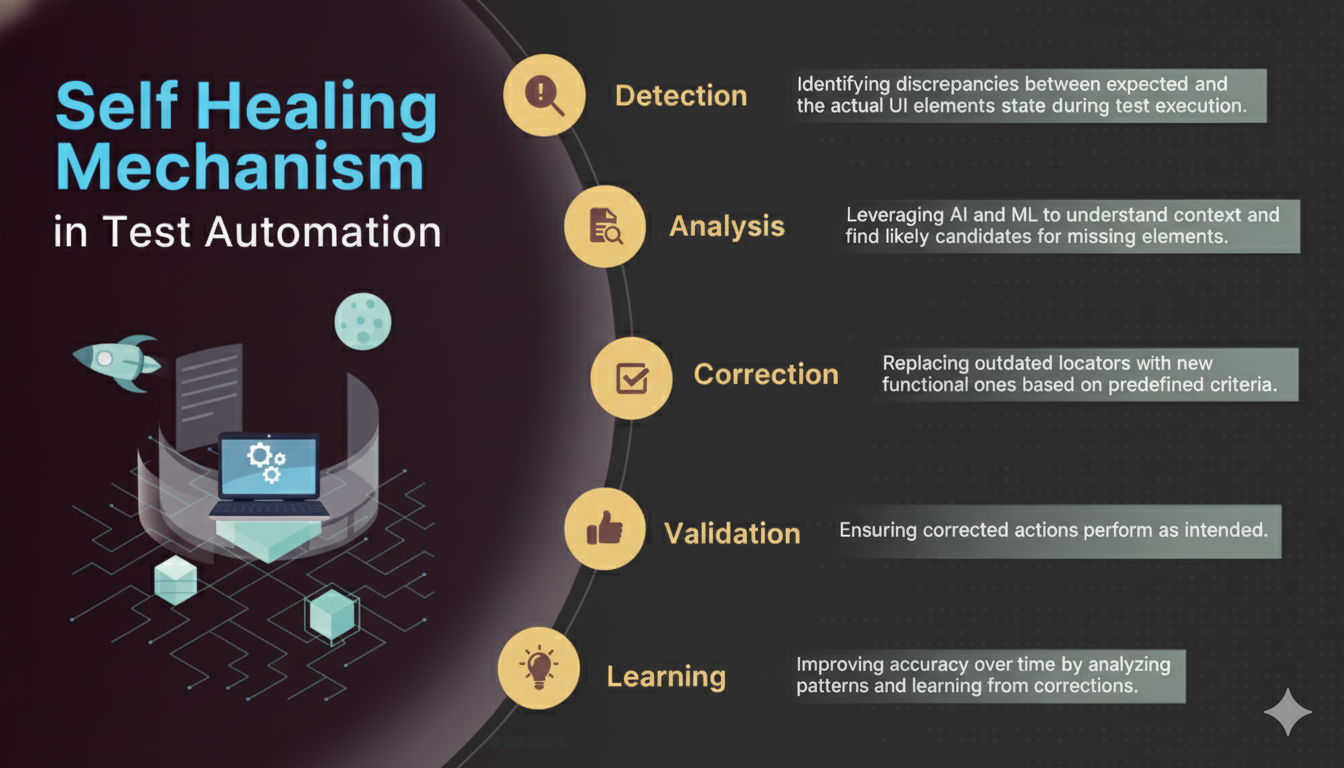
The steps in self-healing automation typically are:
1. Identifying the element
Traditional automation mainly relies on a single attribute to locate an element. But self healing automation tools gather multiple attributes such as name, ID, CSS selector, text, and XPath, along with the element’s relative positioning to others.
This helps the tool get a complete understanding of elements to ensure it can consistently locate these elements even when the app undergoes changes.
2. Organized test execution
Self healing testing follows a planned test script that includes pre-defined steps. The testing tool interacts with the elements of your app according to these steps.
If it cannot find an element through its primary identifier, it searches for it using other identifiers to ensure testing aligns with the original test script. This helps you assess your app’s functionality under the specified scenarios.
For example, if a test step states clicking a button, the tool will attempt to locate the button using its main identifier, such as the element’s ID.
3. Fixing broken tests
Self healing automation tools use algorithms to detect and adapt to broken test cases during execution so they remain relevant when your app evolves over time.
When a tool cannot find an element using its primary identifier, possibly because of app changes, it doesn’t flag the test as failed. The tool instead tries to locate the element by its secondary identifiers or attributes that were recorded during initial test design.
Continuing with the example discussed in the previous point. If the tool cannot find the button using its main identifier, it looks for other alternatives like the button’s text label, class, or position to continue execution.
Traditional tools might fail here, but CoTester’s AgentRx engine re-maps tests during execution, preventing false failures and ensuring your automation suite evolves with your app.
4. Validating new test case and continuous learning
After the test is fixed, the tool runs a check to verify if the test case runs as intended. In case it doesn’t, the algorithm will again review the failure and try alternative options, or flag the issue for further manual review.
The goal is to update the test script so it reflects the new element identifier or attributes for future testing.
Self-healing test automation learns from every update and correction and keeps improving its ability to adapt better, predict issues, and address them.
CoTester’s, AI-powered auto-heal engine, AgentRx can assist you in this entire process of self-healing test automation to reduce test maintenance and delay in releases.

AgentRx automatically detects even major UI changes, including structural shifts and complete redesigns, and updates your test logic dynamically during the test execution phase.
Technology Behind Self-Healing Test Automation
Here is a breakdown of the technology that powers CoTester’s AgentRx engine:
1. AI and ML algorithms
Deep neural networks in ML processes use multiple data streams simultaneously to make healing decisions with accuracy. The data stream can include DOM structure, visual information, historical data and behavioral patterns.
Datasets consisting of multiple app changes are used to train these networks so they can learn to recognize patterns about how apps evolve and how to adapt the tests.
2. Computer vision
Computer vision changes how self-healing tests recognize and interact with your app’s elements.
So, rather than depending on fragile technical selectors that might break with HTML changes, computer vision can identify the elements on your app by their visual appearance and purpose.
This process is very similar to how humans interact with apps, such as clicking buttons and filling out forms.
3. Pattern recognition and adaptation
Self-healing test automation tools analyze thousands of test executions to understand how apps behave, how they change, and how tests interact with their elements.
The tool recognizes the patterns and enables predictive healing that anticipates what changes your app is likely to undergo and prepares for adaptation.
By combining AI/ML, computer vision, and pattern recognition, CoTester delivers self-healing automation that scales reliably across enterprise use cases.
Scenarios Where Self-Healing Automation Helps
1. Dynamic wait mechanism
In traditional automation, a test waits for a page to load completely before it starts interacting with its elements. But this can cause failures due to premature interactions. With self-healing, you don’t have to opt for fixed wait times.
You can dynamically adjust the waiting period based on element readiness and visibility. This helps you speed up test execution and reduce unnecessary delays in release.
2. Self-healing API tests
Self healing tests can help you automatically make changes in your API responses, ensure schema updates, and fix request structures without failing.
So, if an API response structure changes but the core data remains the same, self healing tools automatically modify the feature’s verification logic and prevent the test from failing.
3. AI element recognition
You can use AI-powered tools to automatically recognize elements based on their appearance rather than static locators.
Technologies like computer vision and Machine Learning (ML) allows you to do this. If the structure of a web app form, for example, changes but the submit button looks similar in terms of shape or color, AI can identify and interact with it.
Rounding Off
As the pressure of continuous releases increases owing to growing customer expectations, you cannot afford rising maintenance costs, wasted QA hours, and delayed releases.
Self-healing automation helps you directly address this problem by detecting code changes, adapting locators, and repairing broken scripts in seconds.
To get the most out of self healing automation, structure your tests well. For complex UI, back self-healing tests with visual testing to maintain accuracy despite design changes. Finally, monitor self-healing events to keep track of your app changes and ensure traceability.
Self-healing automation is the key to keeping pace with modern release cycles. Tools like CoTester, with its AgentRx self-healing engine, give QA teams the resilience they need, minimizing maintenance costs while improving delivery speed and test coverage.